

Introduction
For decades, the standard for professional life was rigid. You woke up, commuted to an office, worked at a desk for eight hours, and then commuted home. It was a routine that few questioned because it was the only option available. But the last few years have completely reshaped how we view productivity and the workplace. We have entered a new phase of professional history, one defined not by where you are, but by what you do.
This shift has introduced a concept that is quickly becoming the standard for businesses worldwide: hybrid employment.
It is no longer just a perk or a temporary fix for emergency situations. It is a fundamental change in the relationship between employees and their employers. This guide explores exactly what this model looks like, why it matters, and how it is changing the way we live and work.
What is Hybrid Employment?
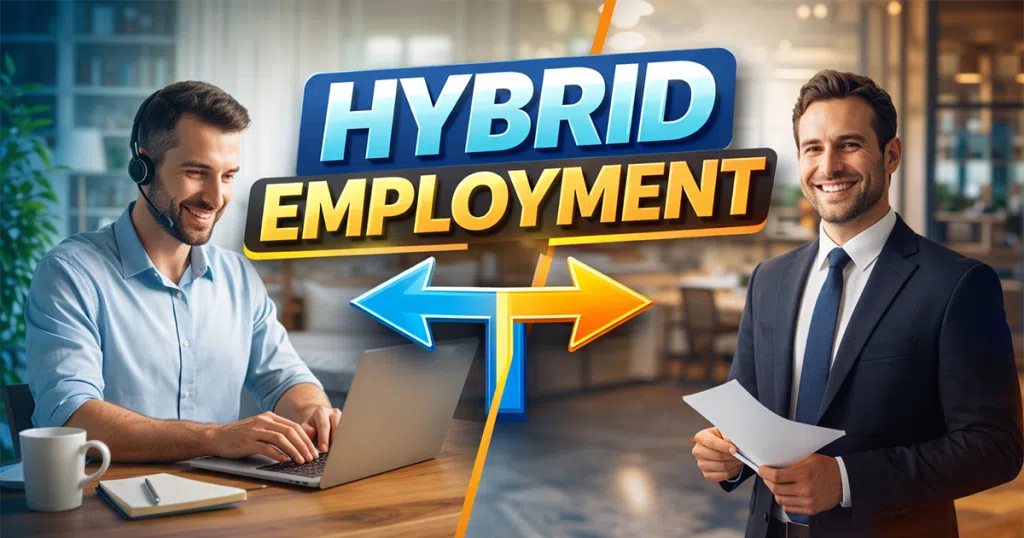
At its core, hybrid employment is a flexible work model that combines remote work with in-office work. It offers employees the ability to split their time between working from home (or another remote location) and working from a physical office space.
Unlike fully remote positions where an employee might never meet their team in person, or traditional roles that require daily attendance, this model sits comfortably in the middle. It acknowledges that some tasks are better performed in solitude, like deep writing or coding, while others benefit from face-to-face collaboration, such as brainstorming or team building.
There isn’t a single way to structure hybrid employment. Some companies mandate specific days in the office (for example, Tuesdays and Thursdays), while others leave the choice entirely up to the individual. The defining feature is flexibility. It is about autonomy and trust. The employer trusts the employee to manage their time and output effectively, regardless of their physical location.
The Importance of Hybrid Employment
Why is everyone talking about this shift? The importance of hybrid employment lies in its ability to solve modern workforce challenges. The traditional 9-to-5 model was already showing cracks before the global events of 2020 accelerated the change. Burnout was high, commuting was expensive and stressful, and many talented individuals were leaving the workforce because they couldn’t balance their careers with their personal lives.
This model is important because it democratizes opportunity. It opens doors for parents who need to be home for school drop-offs. It helps people with disabilities who might find a daily commute physically draining. It allows those living outside of major city centers to access high-quality jobs without relocating.
For businesses, adopting hybrid employment is crucial for retention. In a competitive job market, top talent often prioritizes flexibility over salary. Companies that refuse to adapt run the risk of losing their best people to competitors who offer a more balanced lifestyle. It signals that a company values output over presence, which is a significant cultural maturity marker.
Benefits of Hybrid Employment
The transition to this new way of working brings distinct advantages. These benefits impact the individual employee, the management team, and the organization as a whole.
Improved Work-Life Balance
The most cited benefit is a better balance between professional and personal responsibilities. Without a daily commute, employees gain back hours of their week. This time can be used for exercise, sleep, hobbies, or spending time with family. When employees feel their personal lives are respected, their job satisfaction invariably rises.
Higher Productivity
Contrary to the old belief that people slack off at home, data suggests that hybrid employment often boosts productivity. Without the constant interruptions of an open-plan office, workers can engage in “deep work.” They can focus on complex tasks in a quiet environment at home, then use their office days for meetings and collaborative projects. This segmentation of tasks leads to more efficient workflows.
Cost Efficiency
There are financial wins on both sides. Employees save money on gas, train tickets, work clothes, and daily lunches out. Employers can downsize their real estate footprint. If only half the staff is in the office on any given day, the company doesn’t need a desk for every single person. These savings can be reinvested into technology or employee wellness programs.
Expanded Talent Pool
When a company embraces hybrid employment, they are not strictly limited to hiring people who live within a 20-mile radius of the headquarters. While they may still need employees to be close enough to commute occasionally, the radius expands significantly. Someone might be willing to drive two hours once a week, but not every day. This allows companies to find the best person for the job, not just the closest one.
How Hybrid Employment Works
Implementing this model requires more than just giving employees a laptop and saying “good luck.” Successful hybrid employment relies on clear structure, robust technology, and intentional communication.
The Schedules
There are generally three ways this works in practice:
- The Fixed Schedule: The company sets specific days for in-office attendance. This ensures that teams are together at the same time.
- The Flexible Schedule: Employees choose which days they come in based on their workload for the week.
- The Remote-First Model: The default is remote work, and the office is only used for specific events or quarterly meetups.
The Technology Stack
You cannot have a functional hybrid team without the right digital tools. Cloud-based software is the backbone of this system. Teams use tools like Slack or Microsoft Teams for instant communication, Zoom for video conferencing, and Asana or Trello for project management. The goal is to create a “digital headquarters” that is just as important as the physical one.
The Culture of Documentation
In an office, you might tap someone on the shoulder to ask a quick question. In a hybrid setup, that information needs to be documented so everyone has access to it, regardless of where they are working. This shift toward asynchronous communication—where you send a message and don’t expect an immediate reply—is vital for making hybrid employment sustainable.
Uses of Hybrid Employment in Daily Life
How does this actually look on a Tuesday morning? The impact of hybrid employment on daily life is profound because it integrates work into life, rather than forcing life to fit around work.
Imagine a marketing manager named Sarah. Under a traditional model, she would rush out the door at 7:30 AM, sit in traffic for 45 minutes, work until 5:00 PM, and rush home exhausted.
With hybrid employment, her Tuesday looks different. She works from home. She wakes up and enjoys breakfast with her kids. She starts work at 8:30 AM. At lunch, instead of eating a sandwich at her desk, she goes for a run or puts a load of laundry in. She finishes her tasks by 5:00 PM and is immediately present for her family.
On Wednesday, she goes into the office. She uses this day to have lunch with colleagues, attend a brainstorming workshop, and have a one-on-one meeting with her boss. She utilizes this time for social connection, which she missed the day before.
This model also changes how we use our cities. Coffee shops near residential areas become workspaces. Gyms see more traffic during the day. The rigid structures of “rush hour” begin to soften as people travel at different times.
Advantages and Disadvantages of Hybrid Employment
While the benefits are clear, no system is perfect. It is honest and necessary to look at both the pros and cons to understand the full picture of hybrid employment.
The Advantages
- Autonomy: Employees feel empowered when they have control over their schedule.
- Health: Less exposure to sick colleagues and more time for healthy habits like home cooking.
- Environmental Impact: Fewer cars on the road means reduced carbon emissions.
- Adaptability: Companies that are set up for hybrid work are more resilient during crises (like severe weather or health emergencies).
The Disadvantages
- Proximity Bias: There is a risk that managers might unconsciously favor employees they see in the office every day over those working remotely. This can affect promotions and raises.
- Communication Silos: If not managed well, remote workers can feel out of the loop. Information might be shared in the office kitchen that remote workers never hear.
- Burnout and “Always-On” Culture: When your home is your office, it can be hard to unplug. The boundary between work time and personal time can blur, leading to exhaustion.
- Technical Issues: Reliance on home internet connections can sometimes lead to frustration if technology fails.
Employers must be proactive in mitigating these downsides. This involves training managers to recognize proximity bias and ensuring that all meetings are inclusive, with every participant logging in from their own laptop even if some are in the same room.
The Future of Hybrid Employment
Is this just a trend? All signs point to no. Hybrid employment is likely here to stay and will continue to evolve. As technology improves, the friction between remote and in-person work will decrease.
We are already seeing the rise of virtual reality (VR) meeting rooms, where avatars of colleagues can sit around a virtual table. This could bridge the gap of “presence” that is sometimes missing in video calls. Artificial intelligence will also play a role, helping to summarize meetings and manage schedules to ensure that when people do come to the office, it is for a meaningful purpose.
Furthermore, office spaces themselves are changing. The days of endless rows of cubicles are numbered. Future offices will be designed as collaboration hubs—spaces meant for socializing, whiteboarding, and hosting events. The desk work will happen at home; the “people work” will happen in the office.
We may also see a shift in how success is measured. The focus will move entirely away from hours worked to outcomes achieved. It won’t matter if you worked four hours or eight hours, as long as the project was completed to a high standard. This results-oriented mindset is the natural evolution of hybrid employment.
Embracing the Change
The transition to hybrid employment is one of the most significant changes to the labor market in a century. It represents a move away from rigid control toward flexibility and trust. For employees, it offers a chance to build a career that fits their life, rather than a life that fits their career. For employers, it offers a pathway to a happier, more productive, and loyal workforce.
There will always be challenges in adopting new ways of working. Communication habits need to change, and managers need to learn new skills. However, the potential upside is enormous. By embracing this model, we can create a future of work that is more human-centric, sustainable, and effective.
As we look forward, the question isn’t whether hybrid employment is “right” or “wrong.” The question is how we can optimize it to ensure it works for everyone. Whether you are a CEO or a junior associate, understanding and adapting to this model is the key to thriving in the modern world.